Careers
China Top 10 Chemical Analysis Companies for Global Buyers
China Top 10 Chemical Analysis Companies for Global Buyers introduces laboratories and service providers supporting international quality decisions. The selection considers testing capability, technical expertise, accreditation, equipment, industry coverage, and communication standards. It also examines practical details, such as sample handling, reporting time, method validation, and certificate clarity. These factors matter when a buyer must verify raw materials, polymers, pharmaceuticals, coatings, or environmental samples.
Izaak M. Kolthoff, widely regarded as a pioneer of modern analytical chemistry, famously said, “Analytical chemistry is what analytical chemists do.” His statement remains relevant. Reliable chemical analysis depends on trained people, suitable methods, and careful interpretation. Sophisticated instruments alone cannot guarantee a useful result. A clear report should connect measurements with the buyer’s actual decision.
This guide is designed for global buyers comparing Chinese suppliers with greater confidence. It highlights laboratories that demonstrate relevant experience and transparent technical processes. Some companies may excel in metals, while others focus on organic compounds, chromatography, spectroscopy, or materials testing. No ranking is permanent. Public information can be incomplete, and a strong laboratory for one project may be unsuitable for another. Buyers should still confirm current accreditation, test scope, laboratory capacity, and export documentation before signing a contract. Small details matter. A mislabeled sample can delay an entire shipment. This introduction therefore treats the list as a practical starting point, not a final verdict.

What Chemical Analysis Companies Do for Global Buyers
China Top 10 Chemical Analysis Companies for Global Buyers
Chemical analysis companies support global buyers by turning physical samples into dependable technical evidence. They test raw materials, industrial chemicals, coatings, polymers, water, and finished products. Common services include purity testing, elemental analysis, moisture measurement, chromatography, spectroscopy, and contamination screening.
A professional laboratory begins with sampling instructions. It records the sample condition, collection time, seal number, and storage temperature. This chain of custody helps buyers trace each result back to a specific shipment. Experienced analysts also select methods that match the material, rather than forcing every sample through one procedure. That detail matters. A food-grade material, for example, may require different preparation from an industrial solvent.
Reports usually include test methods, detection limits, units, uncertainty, and acceptance criteria. These details help purchasing teams compare suppliers and investigate failed batches. Some laboratories also support method validation, production troubleshooting, supplier audits, and regulatory documentation for international trade. Buyers should confirm accreditation scope, analyst qualifications, equipment maintenance, and turnaround times before placing an order.
Results are never magic. Poor sampling can weaken excellent laboratory work. A sealed container may still represent only one corner of a large shipment. Laboratories can also misunderstand unusual matrices when project information is incomplete. Clear specifications, representative samples, and direct technical communication reduce these risks. Buyers should ask how a laboratory handles retesting, deviations, data corrections, and confidential information. Reliable analysis depends on disciplined processes, not impressive wording.
China Top 10 Chemical Analysis Companies for Global Buyers - What Chemical Analysis Companies Do for Global Buyers
| Rank | Anonymous Provider Profile | Primary Analytical Coverage | Typical Buyer Industries | Common Methods and Instruments | International Buyer Support | Typical Routine Turnaround | Quality and Compliance Indicators | Best-Fit Purchasing Need |
|---|---|---|---|---|---|---|---|---|
| 1 | Provider Profile 01 | Organic compounds Impurities Residual solvents | Pharmaceuticals, fine chemicals, active ingredients, intermediates | HPLC, GC, GC-MS, LC-MS, NMR, FTIR | English reports, sample logistics coordination, method-transfer support | 5–10 business days | ISO/IEC 17025 scope commonly available | Identity, purity, impurity profiling, and release testing |
| 2 | Provider Profile 02 | Metals Trace elements Mineral composition | Mining, catalysts, pigments, coatings, ceramics, fertilizers | ICP-OES, ICP-MS, AAS, XRF, ion chromatography | Multi-language quotation support, export documentation, customized reporting | 3–8 business days | Documented calibration and quality-control procedures | Raw-material verification and elemental compliance screening |
| 3 | Provider Profile 03 | Polymers Plastics Rubber Additives | Automotive, electronics, packaging, construction materials | FTIR, DSC, TGA, GPC/SEC, DMA, pyrolysis-GC-MS | Pre-shipment sample review, comparative analysis, technical consultation | 7–15 business days | Method validation and instrument traceability available | Material identification, failure analysis, and formulation comparison |
| 4 | Provider Profile 04 | Food-contact chemicals Packaging safety Migration testing | Food packaging, consumer goods, printing inks, adhesives | GC-MS, LC-MS/MS, ICP-MS, migration cells, UV-Vis | Regulatory-screening packages, English certificates, export-market support | 7–12 business days | Accreditation may cover selected regulatory methods | Food-contact compliance and restricted-substance screening |
| 5 | Provider Profile 05 | Environmental samples Water Soil Waste | Industrial manufacturing, environmental engineering, chemicals | Ion chromatography, TOC, GC-MS, ICP-MS, spectrophotometry | Sampling plans, chain-of-custody documentation, data-quality summaries | 5–15 business days | Quality-control blanks, spikes, duplicates, and calibration checks | Discharge monitoring and contamination investigations |
| 6 | Provider Profile 06 | Cosmetics Personal care Preservatives | Cosmetics, toiletries, fragrances, household formulations | HPLC, GC-MS, microbial enumeration, preservative challenge testing | Formula review, restricted-ingredient screening, export dossier support | 7–20 business days | Selected microbiological and chemical methods available | Ingredient verification, stability support, and safety screening |
| 7 | Provider Profile 07 | Battery materials Electrolytes Cathode and anode materials | Lithium-ion batteries, energy storage, electronic materials | Karl Fischer, ICP-OES, XRD, SEM-EDS, particle-size analysis, GC-MS | Confidential project handling, technical data review, supplier qualification support | 10–20 business days | Controlled sample preparation and repeatability checks | Incoming-material qualification and production troubleshooting |
| 8 | Provider Profile 08 | Construction chemicals Cement additives Admixtures | Concrete, cement, waterproofing, sealants, building materials | XRF, XRD, FTIR, ion chromatography, rheology, thermal analysis | Project-based testing, product benchmarking, technical English reporting | 8–18 business days | Standard-method testing and documented equipment calibration | Composition verification and performance-related diagnostics |
| 9 | Provider Profile 09 | Agricultural chemicals Pesticide residues Fertilizers | Crop protection, fertilizers, agricultural raw materials | LC-MS/MS, GC-MS/MS, ICP-OES, ion chromatography, wet chemistry | Residue-panel design, export-market testing, batch-release documentation | 7–15 business days | Multi-residue workflows and proficiency-control practices | Formulation confirmation and residue compliance testing |
| 10 | Provider Profile 10 | Specialty chemicals Process development Unknown materials | Industrial chemicals, electronics, coatings, research and development | NMR, HRMS, GC-MS, LC-MS, FTIR, elemental analysis | Non-routine method development, confidential reports, technical consultation | 10–25 business days | Project-specific validation and peer technical review | Reverse engineering, impurity identification, and R&D support |
Related Posts
-
Top 5 Chemical Analysis Techniques Every Scientist Should Know
-
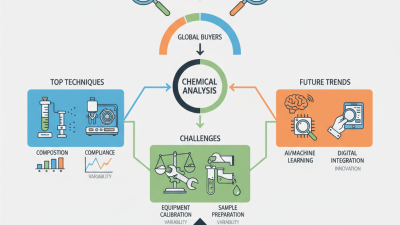
Top Chemical Analysis Techniques for Global Buyers?
-
Why is Chemical Analysis Essential in Scientific Research?
-
10 Essential Tips for Effective Chemical Analysis Techniques?
-
What Are High Purity Chemicals and Their Uses in Industry?
-
10 Essential Tips for Safely Handling Pure Nitric Acid in Laboratories